Driveway Drainage & Regrading: Fixing Water Problems Before They Ruin Your Asphalt
A puddle that sits on your driveway for a day after every rain isn't a small cosmetic issue — it's actively shortening the life of the asphalt underneath it, and in winter it becomes a sheet of ice. Drainage problems are one of the most common reasons a driveway fails years before it should, and most of them are fixable without a full tear-out.
Why standing water destroys asphalt
Asphalt is not waterproof at a microscopic level — it's a mix of aggregate and asphalt binder with small voids throughout. Water that sits on the surface for extended periods works its way into those voids and into any surface cracks, and every freeze cycle that follows expands that trapped water and widens the damage.
Standing water also breaks down the asphalt binder itself over time through a process called stripping, where water displaces the binder from the aggregate, leaving the surface weak, crumbly, and prone to potholing right in that spot.
The base layer underneath suffers too — if water penetrates down to the gravel base and subgrade soil, it can cause soft spots and settling that show up as depressions in the asphalt surface, which then collect even more water, accelerating the whole cycle.
Proper driveway pitch: what it should be and why it's often wrong
A correctly graded driveway should slope at roughly 1-2% grade (about 1/8 to 1/4 inch of drop per foot) directing water away from the garage and house foundation toward the street or a drainage point, never toward the structure.
A huge number of drainage problems we diagnose come from a driveway that was paved directly over an old, already-settled base without correcting the grade first — basically locking in the wrong slope under a fresh layer of asphalt, which just hides the problem for a year or two until it reappears.
Additions, landscaping changes, or a neighboring property's regrading project can also change how water flows toward your driveway over time, even if your driveway's own grade hasn't changed — so a drainage problem that's new this year doesn't necessarily mean your driveway itself failed.
Diagnosing where the water problem actually starts
Before recommending any fix, we watch how water actually moves during or right after a real rain rather than guessing from a dry-day inspection — a driveway can look fine bone-dry and reveal a clear low spot or misdirected flow the moment it rains.
We check whether the problem is isolated to the driveway surface itself (a birdbath or low spot from settling) versus a broader site drainage issue where water from the roof, yard, or a neighboring lot is draining across the driveway rather than around it.
Gutter downspouts discharging directly onto or near the driveway are a frequent, easily-overlooked contributor — sometimes the fix isn't the driveway at all, it's a downspout extension redirecting water 6-10 feet further away.
Fix options: from simple to full regrade
For small isolated low spots (a birdbath under a few square feet), an infrared asphalt patch repair can often correct the local dip without disturbing the surrounding driveway — this reheats the existing asphalt, allows regrading of just that section, and blends it seamlessly with the rest of the surface.
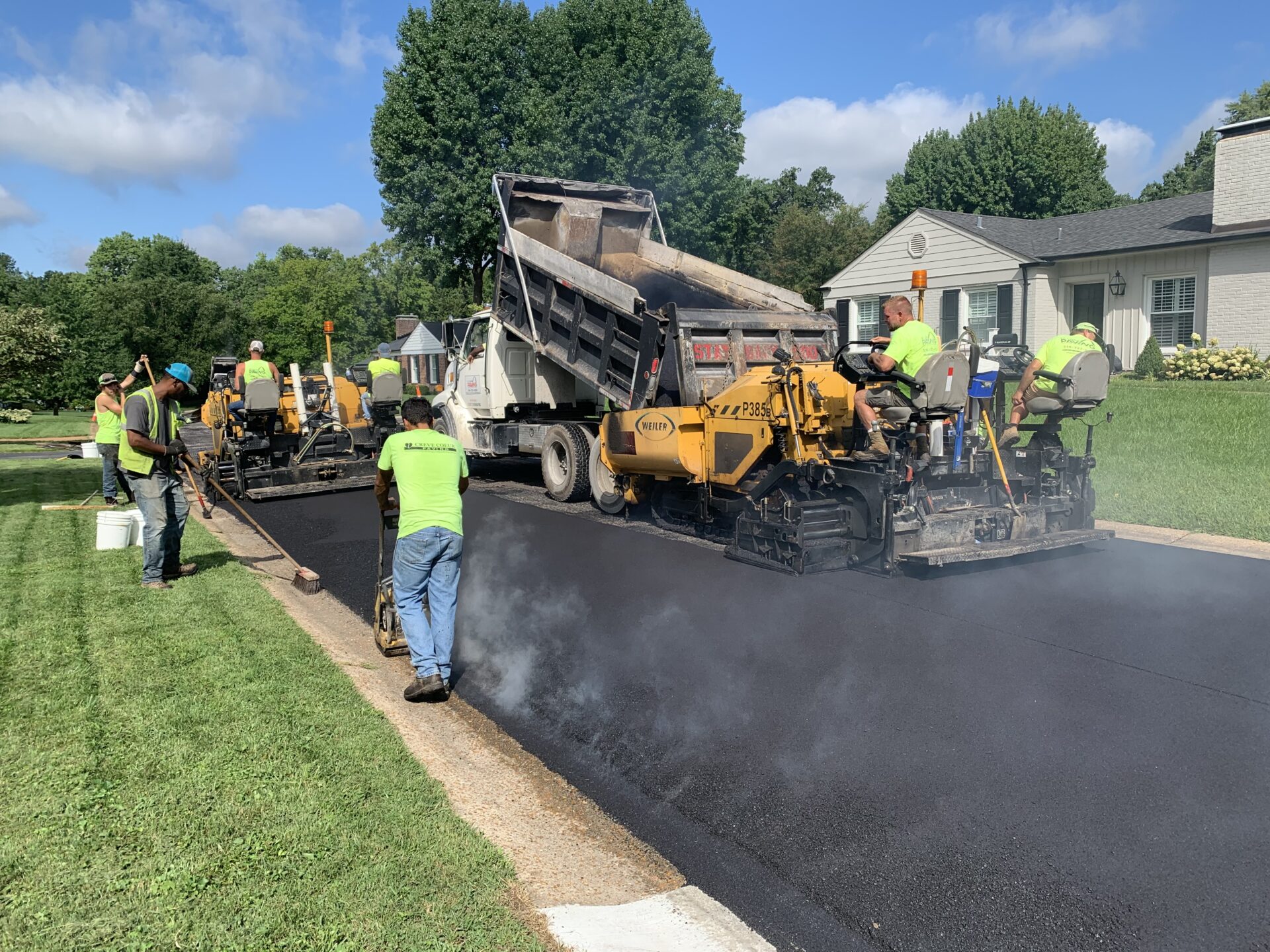
For a driveway with a broader grading problem — water flowing toward the garage across a wide section — a full mill-and-repave corrects the grade properly by removing the top layer, adjusting the base as needed, and repaving with the correct slope built in from the start.
For situations where the problem originates from surrounding grade (yard runoff, a neighboring property, or a low point that can't be graded away), a French drain or trench drain installed at the low edge of the driveway captures water before it can pool and channels it to daylight or a dry well elsewhere on the property.
French drains and trench drains: what's actually involved
A French drain is a gravel-filled trench with a perforated pipe at the base, wrapped in filter fabric, that intercepts subsurface and surface water and redirects it away from the problem area. For driveway applications, it's typically installed along the edge where water is entering or pooling, sloped consistently toward a discharge point.
A trench drain (a linear grated drain set into the asphalt or concrete surface itself) is the right call when water is flowing across the driveway surface from a higher point — like at the base of a slope where a driveway meets the garage — capturing surface flow before it can reach the garage door or pool against the house.
Both systems need a proper discharge point — daylighting to a lower grade, tying into a storm drain where municipally permitted, or draining to a dry well — and NJ towns increasingly regulate where you're allowed to discharge stormwater, so we check local requirements before installing either system.
Cost of drainage fixes and regrading
Infrared patch repair for a localized low spot typically runs $400 to $900 depending on the size of the affected area and access.
A French drain installation along a driveway edge runs $25 to $50 per linear foot depending on trench depth and discharge distance, with a typical 40-foot run costing $1,200 to $2,200.
A full mill-and-repave to correct broader grading issues runs comparably to a standard repave job — typically $4 to $7 per square foot — since the grading correction happens during the normal excavation and base work rather than as a separate line item.
Preventing drainage problems on a new driveway
If you're paving a new driveway, insist on a proper grading survey before any asphalt goes down — this is the cheapest point in the entire process to fix a slope problem, since correcting it after paving means tearing up finished asphalt.
Make sure your contractor accounts for where roof downspouts discharge and where yard runoff naturally flows before finalizing the grade plan, not just the driveway's own high and low points in isolation.
Ask specifically about base depth and compaction in low-lying areas of the property — a properly compacted 4-6 inch gravel base under the asphalt resists the settling that creates future low spots, while a thin or poorly compacted base is asking for a birdbath within a few years.
Fix your drainage problem for good with GDL
GDL Solutions diagnoses driveway drainage issues on-site, watching how water actually moves before recommending a patch, regrade, or drain system — and we make sure any new driveway we pave is graded correctly from day one.
Serving Bergen, Essex, Passaic, Hudson, Morris, and Union counties — call (646) 736-8756 or email info@godolsolutions.com for a free drainage assessment.
Frequently asked questions
Why does my driveway have standing water after rain?
Usually a low spot from base settling, incorrect original grading, or water flowing onto the driveway from a downspout, yard slope, or neighboring property. A rain-day inspection identifies the actual cause.
What's the correct slope for a driveway?
A proper driveway grade is roughly 1-2%, or about 1/8 to 1/4 inch of drop per foot, sloping away from the house toward the street or a designated drainage point.
Can a low spot in my driveway be fixed without repaving the whole thing?
Often yes. Small, isolated low spots can be corrected with an infrared patch repair that reheats and regrades just that section, blending with the surrounding asphalt without a full repave.
How much does a French drain cost for a driveway?
Typically $25-$50 per linear foot depending on trench depth and distance to a discharge point, with a common 40-foot installation running $1,200-$2,200.