Stucco Repair vs. Replacement in NJ: How to Tell Which One You Need
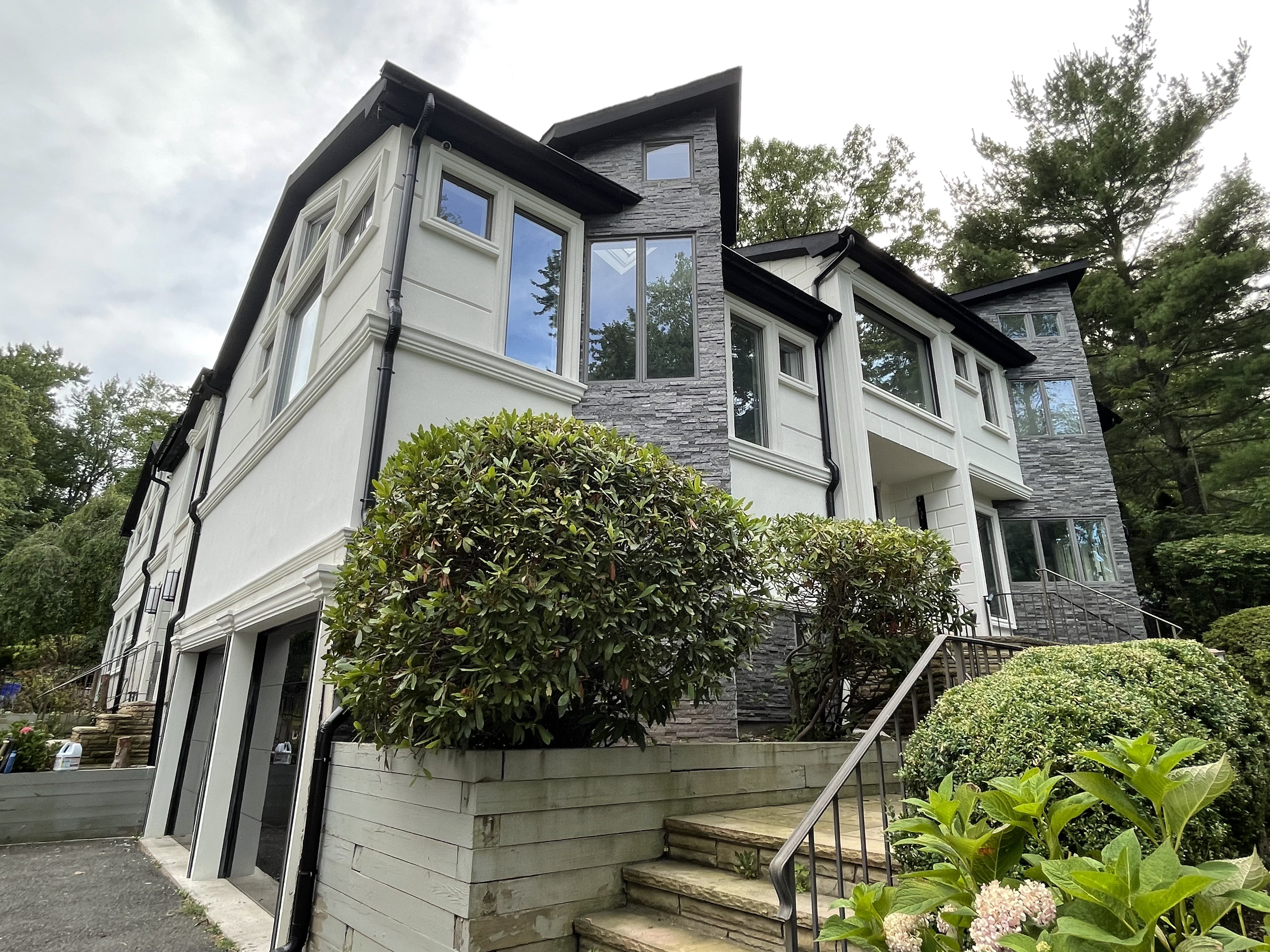
Stucco lasts 50-plus years when it's installed and maintained right, but New Jersey's freeze-thaw winters and humid summers are hard on it. Every week we get calls from homeowners staring at a spiderweb of cracks, wondering if they need a $600 patch or a $15,000 tear-off. The answer depends on what's happening behind the surface, not just what you see on it.
Hairline cracks vs. structural cracks
Hairline cracks under 1/16 inch that run in random directions are usually cosmetic — they come from normal curing and minor settling, and a flexible acrylic patch or elastomeric caulk fixes them for good.
Cracks wider than 1/8 inch, especially ones that run in a straight diagonal line from a window or door corner, are a different story. Those usually point to structural movement, settling foundations, or a header that's flexing. Patching those without addressing the cause just gets you the same crack back in a year.
Stair-step cracking on a stucco-over-block wall is almost always a foundation or mortar joint issue underneath, and it needs a mason's eye before anyone touches the stucco itself.
The garden hose test and other ways to check for water intrusion
Before we quote any stucco job, we run a simple test: spray a section with a garden hose for 15 minutes and check the interior wall for damp spots, staining, or a musty smell over the next 24 to 48 hours. If water's getting in, cosmetic repair is a waste of money.
Soft spots you can push in with a thumb, bubbling paint, dark staining streaks below windows, and stucco that sounds hollow when you tap it are all signs moisture has already gotten behind the assembly. On traditional 3-coat stucco over wire lath, that moisture rots the sheathing and studs behind it over time.
On synthetic stucco (EIFS), the risk is worse because EIFS was designed as a barrier system with no drainage plane in a lot of older installs. Once water gets behind EIFS, it has nowhere to go, and we've opened up walls on 20-year-old EIFS homes to find rotted OSB that looked like wet cardboard.
What real stucco repair involves
A legitimate patch isn't just troweling mud over a crack. We cut back the damaged area to sound material, key in new wire lath where needed, match the scratch and brown coat thickness, and float the finish coat to match the existing texture — sand finish, dash, or smooth trowel.
Color matching is its own skill. Stucco fades with UV exposure over the years, so a patch mixed to the original spec sheet often stands out like a patch. We either blend pigment to the aged color or plan for a full-elevation color coat if the patch is on a highly visible wall.
Every patch gets sealed with an elastomeric or acrylic finish coat rated for NJ's climate swings, which flexes instead of cracking again the next time the temperature drops 40 degrees overnight.
When full replacement is the right call
If more than roughly 25-30% of a wall's surface area needs repair, or if we find rot in the sheathing during exploration, it's more cost-effective and more durable to strip that elevation down to the studs and start fresh with a proper weather-resistant barrier, drainage mat, and new lath.
Homes with EIFS installed before the mid-2000s NJ code updates are common replacement candidates, especially if there's no visible weep screed at the bottom or no sign of a drainage plane. We've converted several EIFS homes in Passaic and Essex counties to traditional 3-coat stucco or fiber cement siding because it's simply more forgiving long-term.
Full replacement runs, on average, $9 to $16 per square foot in North Jersey depending on wall prep, height, and finish texture — a real number, not a lowball, because proper flashing and drainage details take labor that can't be skipped.
Cost breakdown: patch, partial recoat, or full re-stucco
Small crack repairs (under 10 square feet) typically run $400 to $900 depending on access and texture matching. A single-wall partial recoat, where we strip and redo one problem elevation, usually lands between $3,000 and $7,000.
A full-house re-stucco on an average 2,000-2,500 square foot NJ colonial runs $18,000 to $35,000 depending on how much of the substrate needs replacement and whether we're adding a drainage plane that wasn't there before.
It's worth noting that skipping the drainage layer to save money is the single most common reason we get called back to fix stucco a second time. We won't quote a job without one on new installs — it's cheap insurance against the exact problem you're trying to solve.
Maintenance that stretches the life of your stucco
Recaulk expansion joints and control joints every 3 to 5 years — this is the single cheapest thing a homeowner can do and the thing almost nobody does until there's a problem.
Keep gutters clean and downspouts extended away from the foundation. A huge share of the stucco failures we see start with an overflowing gutter dumping water down one wall for years.
Trim landscaping back at least 12 inches from stucco walls so sprinklers and irrigation don't constantly wet the base, and check the weep screed at the bottom of the wall isn't buried under mulch or soil, which traps moisture right where it needs to escape.
Choosing between traditional stucco and siding alternatives
Some homeowners use a stucco problem as the trigger to switch materials entirely. Fiber cement siding (like James Hardie) gives you a similar classic look with better impact resistance and none of the moisture-trapping risk that older EIFS carries.
Traditional 3-coat stucco with a proper drainage plane still performs excellently in NJ's climate and is the right call if you like the look and want to stay consistent with the neighborhood. It's really the older, undrained EIFS systems that cause the most headaches.
We'll walk you through both options honestly during an inspection — we're not going to push a full siding replacement on you when a $2,000 recoat solves the actual problem.
Get an honest stucco inspection from GDL
GDL Solutions has repaired and replaced stucco and EIFS across Bergen, Essex, Passaic, Hudson, Morris, and Union counties, and we tell you straight whether you need a patch or a tear-off before we ever write a quote.
If you're seeing cracks, staining, or soft spots on your stucco, call us at (646) 736-8756 or email info@godolsolutions.com for a free inspection — we'll test for moisture intrusion on the spot and give you real numbers, not a sales pitch.
Frequently asked questions
How much does stucco repair cost in New Jersey?
Small crack repairs run $400-$900. Partial wall recoats run $3,000-$7,000. Full-house re-stucco on an average colonial runs $18,000-$35,000 depending on substrate condition.
Is EIFS the same as stucco?
No. Traditional stucco is a cement-based coating over wire lath. EIFS (synthetic stucco) is a foam board system with a thin acrylic finish coat, and older EIFS installs often lack proper drainage, making them more prone to trapped moisture.
Can I paint over cracked stucco instead of repairing it?
No. Paint will crack again immediately and doesn't address whatever is causing the movement or moisture intrusion. Cracks need to be repaired with proper crack-isolation material before any finish coat or paint goes on.
How long does a stucco repair take?
Small patches take 1-2 days including cure time between coats. Full-wall recoats take 3-5 days. Full-house replacement typically takes 2-4 weeks depending on square footage and weather.