Parking Lot Line Striping & ADA Layout Requirements for NJ Businesses
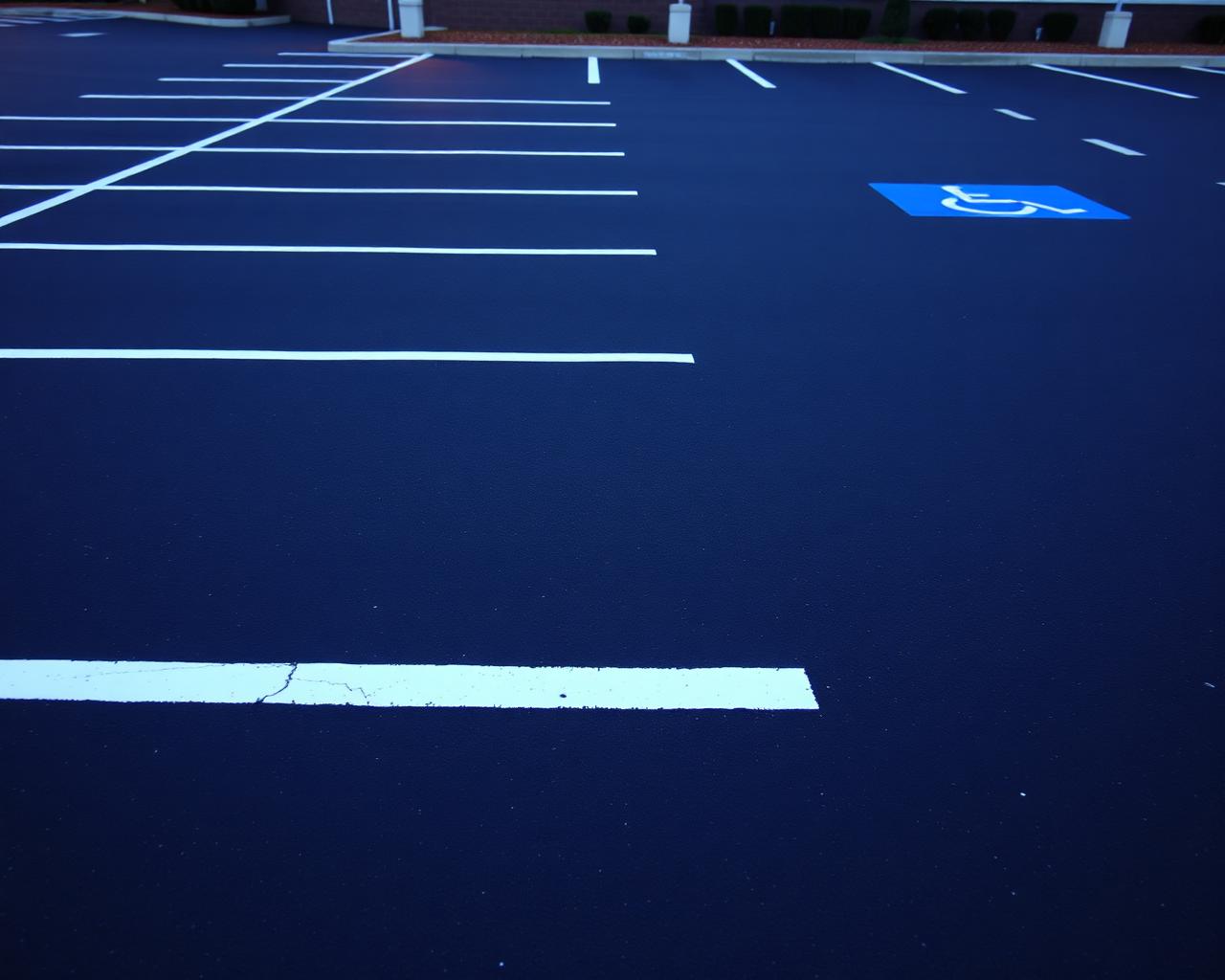
Faded parking lot lines aren't just an eyesore — they're a liability issue and, if your ADA-accessible spaces don't meet spec, a compliance issue that can trigger fines or lawsuits. Here's what NJ commercial property owners actually need to know about striping layout and timing.
Why restriping matters more than most property owners think
Faded lines cause real problems: cars parking crooked and eating into two spots, confused traffic flow that leads to fender-benders in your lot, and pedestrians walking through drive lanes because crosswalk markings have disappeared. Every one of those is a liability exposure for a property owner.
Insurance carriers and slip-and-fall attorneys look at parking lot conditions closely after an incident, and faded or missing striping (especially ADA markings) is exactly the kind of detail that turns a minor incident into a larger liability claim.
On the tenant side, a well-marked, clearly organized lot signals a well-run property, which matters for retail and office tenants deciding between your building and a competitor's down the street.
ADA parking requirements: the numbers that matter
The number of required accessible spaces scales with total lot size: 1 accessible space per 25 total spaces up to 100 spaces, with the ratio adjusting at higher counts. At least 1 in every 6 accessible spaces (minimum 1) must be van-accessible with an 8-foot access aisle instead of the standard 5-foot aisle for car-accessible spaces.
Standard accessible spaces need to be 8 feet wide with a 5-foot access aisle (96 inches + 60 inches), while van-accessible spaces need either an 8-foot space with an 8-foot aisle or a wider 11-foot space configuration, striped with diagonal hatching in the aisle.
Accessible spaces must connect to an accessible route to the building entrance without curbs or steps blocking the path, and signage must be mounted at a minimum height (typically 60 inches to the bottom of the sign in most NJ municipalities) — a detail that's easy to get wrong and easy for an inspector to catch.
NJ also requires accessible spaces to be located on the shortest accessible route to the accessible building entrance, not just anywhere convenient — we survey the site and building entrance before laying out any commercial lot for this exact reason.
Common ADA compliance mistakes we find in NJ lots
The most common issue we find during lot audits: not enough van-accessible spaces relative to total accessible spaces, or a van space striped with a standard 5-foot aisle instead of the required 8-foot aisle.
Slope is another frequent violation — accessible spaces and their access aisles need to be relatively flat (max 2% slope in any direction) for wheelchair users, and older lots built before more recent ADA updates often have accessible spaces on a noticeable grade that technically doesn't comply.
Faded or missing signage, or signage mounted too low or blocked by snow removal equipment in winter, is a simple but common violation that's easy to fix once flagged.
Standard striping layout beyond ADA spaces
Standard parking stalls in NJ commercial lots are typically 9 feet wide by 18 feet deep for 90-degree parking, with drive aisle widths of 24 feet for two-way traffic and 12-18 feet for one-way, depending on your local zoning code and the parking angle used.
Fire lanes need to be clearly marked per your local fire code — usually with red curb paint or striping plus “NO PARKING FIRE LANE” stenciling at regular intervals, and these markings get checked during fire inspections, so faded fire lane marking is a compliance issue beyond just striping upkeep.
Directional arrows, stop bars at exits, and crosswalk striping in high-pedestrian-traffic areas (near entrances, between building sections) round out a complete layout and meaningfully reduce the fender-benders and near-misses that happen in confusing lots.
How often to restripe a commercial lot
High-traffic retail and commercial lots typically need restriping every 1 to 2 years, since constant tire traffic and weather wear fade paint faster than in low-traffic settings.
Lower-traffic office or industrial lots can often go 2 to 3 years between full restripes, though ADA spaces and fire lanes should be checked annually regardless of overall lot traffic since compliance issues carry disproportionate risk relative to their small footprint.
If you're sealcoating the lot (recommended every 2-3 years for commercial asphalt), that's the ideal time to fully restripe as well, since fresh sealcoat needs a full new striping layer anyway and doing both together saves on mobilization costs.
Cost of commercial line striping in NJ
Standard stall striping runs roughly $6 to $12 per stall depending on lot size and paint type (standard traffic paint vs. more durable and reflective thermoplastic). A typical 50-space lot runs $400 to $900 for full restriping.
ADA-compliant space striping including the wheelchair symbol stencil and required signage runs $150 to $300 per accessible space, factoring in the extra stencil work and post-mounted signage.
Full-lot layouts including directional arrows, stop bars, fire lane marking, and crosswalks for a larger commercial lot (100+ spaces) typically run $2,500 to $6,000 depending on complexity and paint type selected.
Non-compliance risk: what it actually costs
ADA lawsuits and demand letters targeting commercial properties are common in NJ and nationally, and parking lot violations (wrong space counts, missing van-accessible spaces, improper signage) are among the most frequently cited issues because they're easy for a plaintiff's inspector to document with a tape measure and a phone camera.
Settlement and legal costs for an ADA parking complaint typically run well into the thousands of dollars even for a straightforward case, dwarfing the cost of a compliant restripe that would have prevented it.
A proactive ADA compliance audit and restripe, done once every couple years as part of routine lot maintenance, is genuinely one of the cheapest insurance policies a commercial property owner can buy.
Get your lot audited and striped by GDL
GDL Solutions handles full commercial line striping and ADA layout compliance across Bergen, Essex, Passaic, Hudson, Morris, and Union counties, including sealcoating and crack repair before striping if your lot needs it.
Call (646) 736-8756 or email info@godolsolutions.com for a free lot audit — we'll flag any ADA compliance gaps and give you a straight quote to fix them.
Frequently asked questions
How many ADA parking spaces does my NJ business need?
Generally 1 accessible space per 25 total spaces up to 100 spaces, with at least 1 in every 6 accessible spaces required to be van-accessible. Exact ratios adjust for larger lots.
How often should a commercial parking lot be restriped?
High-traffic lots every 1-2 years, lower-traffic lots every 2-3 years. ADA spaces and fire lanes should be visually checked annually regardless of overall lot traffic.
What's the difference between a standard and van-accessible ADA space?
A van-accessible space requires an 8-foot-wide access aisle (versus 5 feet for a standard accessible space) to accommodate wheelchair lifts on vans, and needs specific signage indicating van accessibility.
What does it cost to restripe a commercial parking lot in NJ?
Roughly $6-$12 per standard stall and $150-$300 per ADA-compliant accessible space including signage. A typical 50-space lot runs $400-$900 for full restriping.