Cabinets & Countertops: Material Comparison Guide
Cabinet and countertop choices drive most of a kitchen or bathroom remodel's budget and its long-term durability, and there's a lot of marketing noise around both. Here's a plain comparison of what each material actually costs, how it holds up, and where it makes sense.
Cabinet tiers: stock, semi-custom, and full custom
Stock cabinets come in fixed sizes (typically 3-inch increments) from a manufacturer's catalog, ready to ship in days to weeks. They run $150-$300 per linear foot installed and are a solid choice for straightforward layouts, rental properties, or budget-conscious remodels where the box store selection covers your dimensions well.
Semi-custom cabinets offer more size flexibility, door style, and finish options, with a 6-10 week lead time, running $300-$600 per linear foot installed. This is the sweet spot for most homeowners — enough customization to fit an actual kitchen layout without paying full-custom prices.
Full custom cabinetry is built to your exact kitchen's dimensions with unlimited configuration options — corner solutions, appliance integration, specialty storage — running $700-$1,200+ per linear foot with 8-14 week lead times. This makes sense for irregular layouts, high-end finish goals, or kitchens where every inch needs to be optimized.
Cabinet material: plywood vs. MDF vs. particle board boxes
Plywood cabinet boxes hold screws better, resist moisture damage better, and are more durable long-term than MDF or particle board — this is the detail to check regardless of which price tier you choose, since box material matters more for longevity than the door style.
MDF (medium-density fiberboard) is common for cabinet doors because it takes paint smoothly and doesn't show wood grain, making it ideal for painted shaker-style doors. It's not as strong as solid wood for structural components but performs well for door fronts specifically.
Solid wood doors (maple, oak, cherry) cost more than MDF but offer a different aesthetic and are the standard choice for stained (not painted) cabinet finishes, since MDF can't take a wood stain convincingly.
Countertop comparison: quartz
Quartz is engineered stone — roughly 90-95% ground quartz mixed with resin — and runs $70-$120 per sq ft installed. It's non-porous (no sealing ever needed), highly resistant to staining and scratching, and available in consistent patterns since it's manufactured rather than quarried.
The tradeoff is that quartz can be damaged by extreme heat (a hot pan straight from the stove can cause thermal shock and cracking) and it lacks the natural variation some homeowners want from real stone.
Countertop comparison: granite and quartzite
Granite runs $80-$150 per sq ft installed, is naturally heat-resistant (you can set a hot pan directly on it without damage), and each slab has unique natural veining. It requires periodic sealing (typically annually) to stay stain-resistant, since it is a porous natural stone.
Quartzite (often confused with quartz but a completely different, natural stone) runs $100-$200 per sq ft installed, offers a marble-like look with better durability than actual marble, and also requires periodic sealing.
Marble is the classic high-end look at $100-$250 per sq ft installed, but it's genuinely high-maintenance — it etches from acidic foods (lemon, wine, vinegar) and stains more easily than granite or quartzite, which is why we steer most kitchen clients toward it for a bathroom vanity or an accent island rather than a primary work counter.
Countertop comparison: laminate and butcher block
Laminate has come a long way in appearance and runs $20-$45 per sq ft installed — the most budget-friendly option, reasonable for rental properties or a starter-home kitchen, though it can't be repaired if chipped or burned and doesn't add resale value the way stone does.
Butcher block (real wood) runs $40-$100 per sq ft installed depending on wood species, offers a warm look popular for islands, but requires regular oiling and isn't ideal near a sink without careful sealing since wood and standing water don't mix long-term.
Matching cabinet and countertop tier to your actual budget
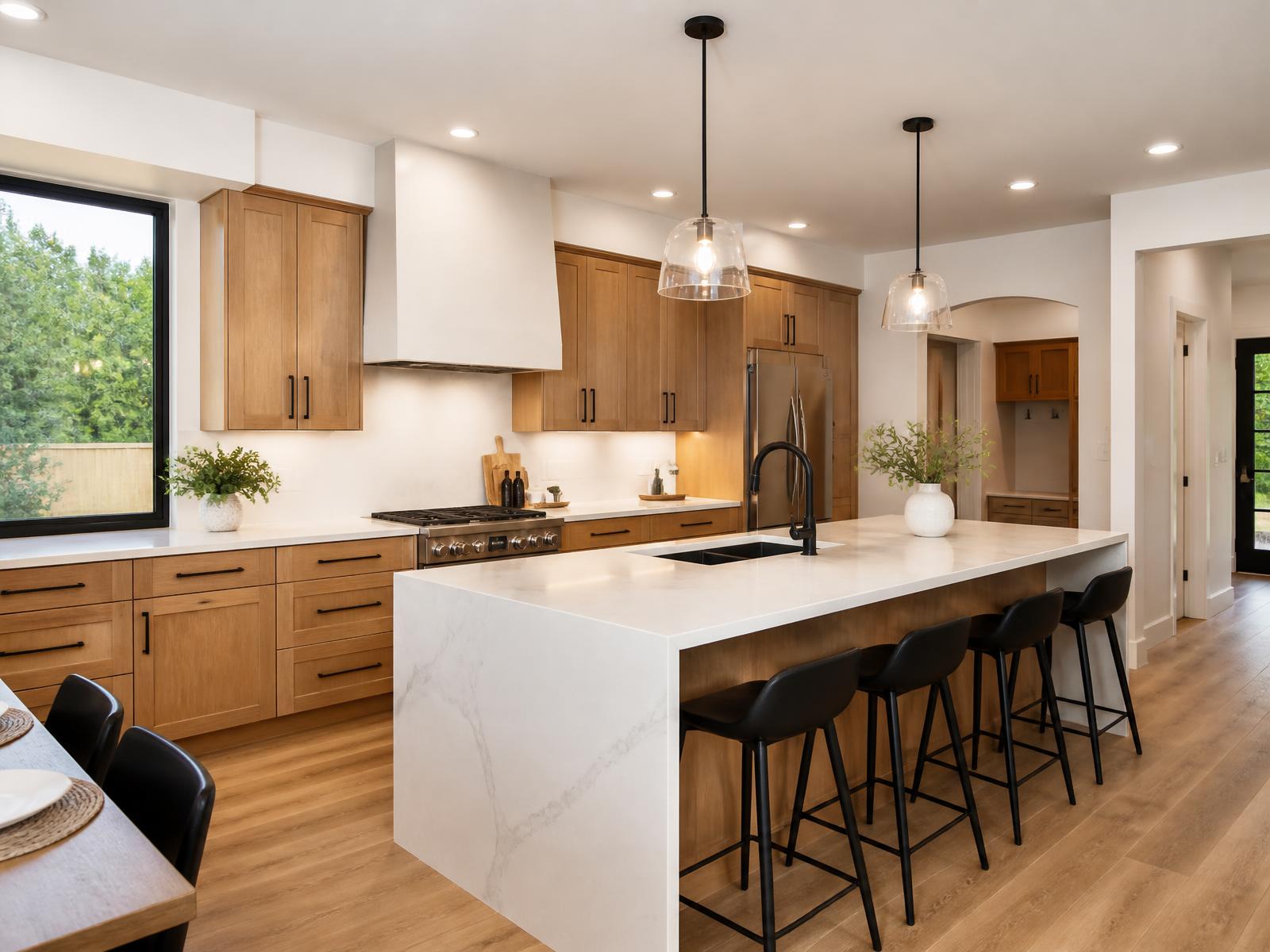
A common mistake is spending unevenly — splurging on full custom cabinetry and then defaulting to the cheapest laminate countertop, or the reverse. We generally recommend matching tiers: semi-custom cabinets pair naturally with quartz or granite counters, giving a cohesive, well-proportioned kitchen without overspending in one area and underspending in another.
If budget is genuinely tight, it's usually smarter to go stock cabinets with a quality quartz counter than full-custom cabinets with laminate — the countertop is what you touch, see, and use daily, and it's harder to upgrade later without disturbing the cabinets and backsplash around it.
Let GDL help you choose the right combination
We walk clients through actual material samples, not just photos, so you know exactly what you're getting before it's installed. GDL Solutions sources cabinets and countertops for kitchen and bathroom projects throughout Bergen, Essex, Passaic, Hudson, Morris, and Union counties. Call (646) 736-8756 or email info@godolsolutions.com to talk through options for your project.
Frequently asked questions
Is quartz or granite better for kitchen countertops?
Quartz needs zero sealing and resists stains better, making it lower-maintenance. Granite handles heat better and offers unique natural veining, but requires annual sealing. Both are excellent, durable choices — the decision usually comes down to maintenance preference and look.
What's the difference between stock, semi-custom, and custom cabinets?
Stock cabinets are pre-sized and fastest to get but least flexible. Semi-custom offers more size and style options with a moderate lead time. Full custom is built to your exact kitchen with unlimited configuration, at a higher price and longer lead time.
Should I match my cabinet tier to my countertop tier?
Generally yes — pairing similar-quality cabinets and countertops gives a more cohesive, proportional result than splurging heavily in one area while cutting corners in the other.